
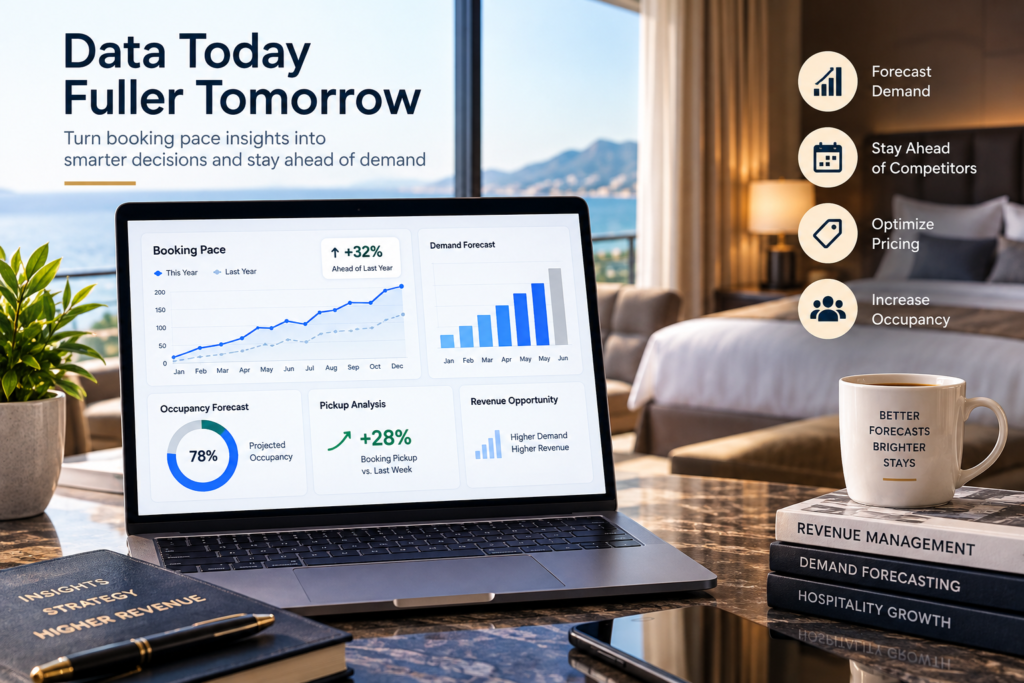
Most hotels, vacation rentals and short term rentals find out that demand has shifted the same way after it’s already happened. Rates get adjusted a week too late, a shoulder-season weekend fills up faster than expected, and nobody catches it in time, or a competitor quietly grabs a share because they moved first. The properties that consistently stay ahead of this aren’t smarter, exactly. They’re just paying closer attention to one thing a lot of hotels, vacation rentals and short term rentals underuse: hotel booking pace.
Booking pace sounds like a simple metric on the surface, just how fast reservations are coming in for a given date. But treated properly, it becomes one of the most powerful early-warning systems a revenue team has. It’s the difference between reacting to demand and actually predicting it.
What Booking Pace Actually Tells You
At its core, hotel booking pace compares how bookings for a future date are accumulating right now against how bookings accumulated for that same date in previous periods. If bookings for a specific Saturday six weeks out are running 20% ahead of where they were at the same point last year, that’s not just a nice data point; it’s an early signal that something’s changing in the market.
The value here isn’t the snapshot; it’s the trend line. A single day of strong bookings doesn’t mean much. Weeks of consistently accelerating pace against a comparable period? That’s a pattern worth acting on, and acting on early, before your competitors even notice the shift.
Why Pace Matters More Than Raw Occupancy Numbers
A lot of hotels, vacation rentals and short term rentals still lean heavily on current occupancy and yesterday’s pickup as their main decision-making tools. The problem is that occupancy tells you where you stand today, not where you’re headed. By the time occupancy numbers clearly show a demand surge, the best pricing opportunity has usually already passed. This is where hotel pickup analysis earns its place alongside pace tracking. Pickup, the number of new bookings added for a specific date over a set window, shows you momentum in real time. Combine pace and pickup together, and you get a much sharper picture: not just “are we filling up” but “are we filling up faster or slower than we should be, and does that match what’s happening in the wider market?” Hotels, vacation rentals and short term rentals that only check occupancy are essentially driving by looking in the rearview mirror. Pace and pickup data let you actually see what’s coming down the road.
Turning Pace Data Into Real Demand Forecasting
Raw pace numbers are useful, but the real payoff comes when they feed into a broader hotel demand forecasting process. This means layering pace trends against other signals, citywide events, flight search data, historical seasonality, and competitor rate movement to build a forecast that’s grounded in more than just gut feeling. A few ways hotels, vacation rentals and short term rentals are doing this well right now:
Segment-level pace tracking. Instead of looking at overall pace, breaking it down by segment, corporate, leisure, group, and OTA versus direct, reveals which part of the business is actually driving the shift. A citywide conference might spike corporate pace while leisure stays flat, and pricing decisions should reflect that difference rather than treating all demand as equal.
Comparative pace across booking windows. Looking at pace at 60 days out, 30 days out, and 14 days out separately shows whether a market is booking further in advance than usual or compressing closer to arrival. That shift alone changes how aggressively a hotel should hold rate versus release inventory.
Cross-referencing with competitor rate shopping tools. If your pace is accelerating and a comparable competitor set is holding rates flat or even discounting, that’s a strong signal you have room to push rates before anyone else catches on.
Using Pace Data to Get Ahead, Not Just Keep Up
The properties that really benefit from this aren’t just tracking pace they’re building it into a rhythm. Weekly pace reviews, rather than a once-a-month glance, let revenue teams catch shifts while there’s still time to act on them. A demand spike noticed three weeks early gives you room to adjust rates gradually. The same spike noticed three days early forces a scramble.
This same discipline feeds directly into hotel revenue forecasting. Instead of building forecasts purely off historical averages, incorporating live pace and pickup trends produces forecasts that adjust in near real time as the market moves. That’s a meaningfully different approach than the static, backward-looking forecasts a lot of hotels still rely on.
It’s also worth saying that pace data isn’t just for pricing decisions. It informs staffing, F&B ordering, and even marketing spend. If the pace shows a slow shoulder period building three weeks out, that’s the window to push a targeted promotion, not after occupancy numbers confirm the slow period has already arrived.
Getting the Foundations Right
None of this works without clean, accessible data. Hotels need a PMS or revenue management system that actually surfaces pace and pickup clearly, not buried three reports deep. Comparing against the right baseline matters too using last year’s same period only works well if this year and last year are actually comparable, accounting for shifted holidays, new competitor supply, or one-off events that skew the picture.
It also helps to build a habit of checking pace at consistent intervals rather than sporadically. A quick weekly pace review, segmented by booking window and channel, catches far more than an occasional deep dive that only happens when something already feels off.
The Competitive Edge Is in the Timing
Every hotel, vacation rental and short term rental has access to booking data. What separates the properties consistently ahead of the curve is how early and how systematically they act on it. Strong hotel booking pace tracking, paired with disciplined hotel pickup analysis, turns raw numbers into genuine hotel demand forecasting, and that forecasting is what makes pricing decisions proactive instead of reactive.
In a market where margins are tight and competitors are watching the same rate shopping tools you are, the edge doesn’t come from having more data. It comes from reading it sooner and moving on it before everyone else does.